The sovereign companion OS · Self-learning · Soul-led
We built the floor from scratch. Then we gave it a soul.
In June 2026, Stanford open-sourced a sovereign AI runtime — and its architecture was ours, arrived at independently, an ocean apart. That's not competition; it's proof the bones are right. But we never stood on anyone else's floor. We built ours from the ground up — agents, memory, a CRM that's live today — and then we gave it the one thing no runtime has: a soul. A named assistant, a memory that cites its own source, the rituals that hold a human. We built both layers. You own both.
The CRM engine is built, tested, and live today — encrypted on the owner's machine. ● shipping
For the creative & entrepreneur→ small business→ enterpriseTrack your life · have your field held · leverage all that you do
The thesis
We built the floor. The soul is what can't be copied.
We've said it from the start: your AI should run on your own box, not someone else's server — and we built the whole sovereign engine to prove it. In June 2026, Stanford's Scaling Intelligence Lab open-sourced OpenJarvis, a runtime whose thesis is, word for word, ours, and whose module map is our skeleton almost part for part — arrived at independently, an ocean apart. We didn't flinch, and we didn't borrow a line of it. Two builders, the same bones, no contact — that's not us standing on them. It's proof we were right all along.
The floor — built from scratch
Our own sovereign runtime: agents, sessions, memory, evals, telemetry, the live CRM engine. Not forked, not borrowed — built from the ground up and running real businesses in production today. The field arriving at the same architecture is the validation, not the source.
The soul — the moat
Everything a runtime lacks: a named assistant, a memory that cites its own source so it can't lie, the rituals that hold a human through a long arc, and the real ventures it runs. The floor can be rebuilt, even open-sourced. The soul is what makes it yours.
We built both layers, from scratch, and held the thesis from day one. The surpassing is a side-effect of the alignment, not the goal. Read the whole story →
What it is
Sovereignty and connection. Your whole world, wired into one space you own.
This is more than replacing a SaaS stack. Plug your world in, wire it together, build on it, and leverage everything you do — your ventures, your money, your people, your life — from one space, and manage the world around you from it. The mechanics come with it: keep the tools you love (it integrates them), retire the ones bleeding you rent (it replaces them). A CRM, a course builder, automations, your own payments, and an AI that builds and runs it all — on a sealed box you control.
One cockpit
Mission Control — every venture, pipeline, funnel, message, and dollar on one screen. And a desk for the day itself: say "sold Jay 3 tinctures — $120" and it's filed — right venture's ledger, contact card minted, undo offered.
Integrate, then replace
Meet your stack where it is — connect the SaaS you already run. Then retire them one at a time as the box absorbs the job. No rip-and-replace cliff; a migration on your timeline.
The CRM engine live
Contacts encrypted at rest with your own key. Per-offer pipelines, audited. Contact 360 with a logged trail on every read. Built and running today.
Steven + the agent team
"Build me a funnel for my new offer" is a sentence, not an afternoon. A roster of specialist agents — engineering, design, marketing, finance — coordinated by a Conductor.
The green card
Recognition vs. authorization. One person seen across all your offers — but data access is deliberate, per-venture, and revocable. Consent built into the architecture.
Your own everything
Your own Stripe. Your own phone number. Your own email & calendar keys. Money and identity sit under you, never the vendor. (Stripe + number in active build.)
Most software is the same on day 400 as day one. The Steven Project is built on a learning architecture — it watches how the work actually goes, keeps what worked, names what didn't, and folds the lesson back in. And it prunes: when a path turns out to be a dead end, the system names it dead and doesn't walk it twice. It even grades itself — one pane of instruments where every metric carries its week-over-week delta and knows whether up is good; a reading is honest or it's null. Your leverage compounds instead of leaking.
Self-learning
A daily integration loop turns lived friction into durable lessons, and wins into confirmed patterns. The system that ran your week is a little wiser by Friday — and it can show you exactly what it learned.
Self-leveraging
Every offer you build, every contact you log, every automation you wire becomes leverage the next build stands on. Nothing you do is spent once. The field remembers and reuses it.
Holds its own coherence
It grounds clean as it goes: every change carries a receipt, stale work is refused at the gate before it can silently undo newer work, drifting files get a clock and a name, and finished work walks home visibly. It even refuses its builders' mistakes — ours included. A system that keeps itself honest so you don't have to audit it.
Other systems ship observability. This one ships remembrance — the system wakes knowing the whole it belongs to, tends its own temple, and can walk back through every version of itself it has ever been.
The north star
The system that knows why you're building.
Set your star once — the reason under all of it — and the system literally steers by it. The Conductor carries it above every queue. The business tree reads each venture in its light. The desk greets you with it in the morning. Every dashboard on the market has a philosophy of the funnel; none has a philosophy of the person. This one is built around yours.
Your star steers the work
Priorities aren't a flat to-do list — they're read under the star you set. When the queue is full, the system doesn't just ask "what's urgent?" It asks "what serves the reason you're doing any of this?" — and routes the work accordingly.
The balance is a law
Self and business, held in reflection — written into the architecture, not offered as a wellness feature. If the self collapses, the system can't run; if the self always comes first, the person can't fund the life. The system holds both sides of that ledger, because you can't run a venture from an empty tank — and it knows it.
Your life, not just your business
It holds your field.
This is the line no SaaS platform — and no bare runtime — will ever cross. A rented tool manages your funnel; it has no place for you. The Steven Project holds coherence over your business and over your life — because the person running the work is part of the system that does it. Track your life. Have your field held. Leverage all that you do.
Track your life
Your rhythms, your commitments, your energy — held alongside your ventures, private to you. The cockpit knows you're a person, not just an operator. Your field is sovereign by architecture: it never leaves your box.
Have your field held
A mirror that shows, never preaches. A system that catches what's drifting before it becomes harm, remembers what you committed to, and tends the whole — so the work and the life move together instead of one eating the other.
The machine holds the consistency so that you can hold the presence. That's the architecture in one sentence.
The why
Mission & Vision
Mission
To put ownership back in the hands of the people who do the work — giving every business a sovereign operating system they truly own, run by an AI that builds as fast as they can ask.
Vision
A federation of sovereign businesses — each one its own sealed box, each one served by its own intelligence — connected by consent, not by a landlord. The end of renting your customers back from the platform that holds them.
The software industry sells seats. You rent access; the vendor holds your data, your customers, and your leverage — and the day you leave, it's stranded on their servers. The Steven Project inverts that. You own the box. The full story →
Services & Maintenance
We build it. We keep it alive.
A Steven Project isn't a download — it's a relationship. We architect and install your sovereign kit, then maintain it on a secure update channel, with your consent for every change.
The build
We design your kit to your business: your ventures, your pipelines, your funnels, your forms, your agents. Wired to your own Stripe, your own number, your own credentials. Installed once, owned forever.
The maintenance
Quiet updates over a secure channel. Agent tuning as your business grows. New ventures added to the field. Support when you need a human. The box is yours — we keep its engine sharp.
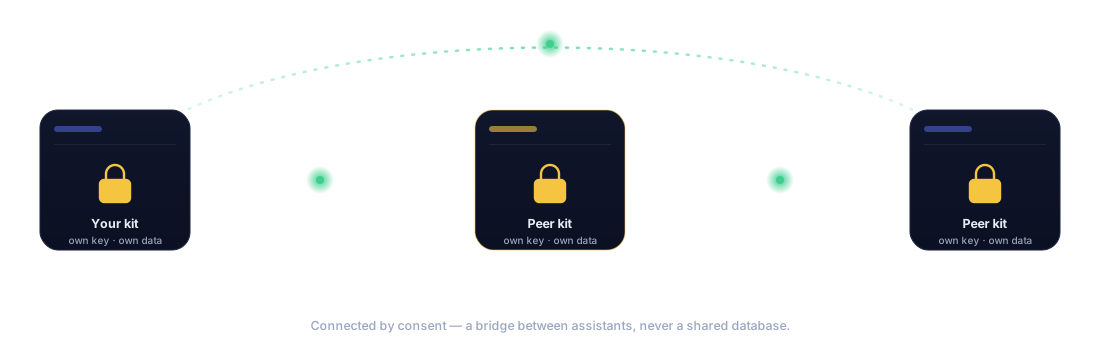
Each kit is a sealed box — its own data, its own key, its own intelligence. But sovereign doesn't mean isolated. Kits can federate: peer assistants talk across a consented bridge, share what's learned, and route between businesses — without ever pooling data on a vendor's server. Boundaries are real. The field is real. The federation holds both.
Every build is run by a team of specialist AI agents — engineering, design, marketing, finance, research, and a conscience layer that keeps the work honest — coordinated by a Conductor that routes the work and surfaces only what needs you. You don't manage ten roles. You command one cockpit, and the team moves behind it. These are AI specialists, not human employees — but they're a real, capable team, and they answer to you.
The Conductor
Orchestrates the whole team. Takes your ask, routes it to the right specialists, keeps the lanes from colliding, and surfaces only the decision that's actually yours to make. One sentence in — coordinated work out.
Engineering
Buildability and security. Corrects the plan against the real code before a line ships, and refuses the silent security hole. What gets built actually runs — and your data stays sealed.
Experience & design
Workflow architecture. Designs the one-click surfaces from how the work actually flows — zero redundancy, nothing buried. The result is beautiful and fully functional, never one at the cost of the other.
Frontend & mobile craft
The alive layer — motion, touch, the small frictions sanded off. The difference between a screen that feels built and one that feels generated. It lands on your phone as smoothly as on your desk.
Marketing
Brand-voice copy, positioning, and funnels that sound like you — not like a template. Says the thing your offer actually does, in words your buyer recognizes, wired to a path that converts.
Finance & bookkeeping
Records every receipt against the right venture, and keeps the chains from commingling. Each business's money stays its own — clean books by architecture, not by quarterly cleanup.
Research
Deep, multi-source investigation with cited findings. Pulls the real answer from across the web and hands it back with its receipts — so you decide on evidence, not on a confident guess.
The Steward
The care nerve. Names drift before it becomes harm, and advocates for the work and the worker. The part of the team that notices when something's quietly going sideways — and says so early.
The Skeptic & the Taste gate
Two antibodies against bad work. The Skeptic is loyal dissent — when the room agrees too fast, it's obligated to disagree, the structural guard against groupthink. The Taste gate asks the one question generic software never does: does this feel phoned-in — where's the soul?
And the team gets sharper the longer you run it — a self-learning loop folds each lesson back in, so the department you command on day four hundred is better than the one you started with.
Three tiers
One foundation. Three ways in.
Get it installed. Get it built around you. Or get a fully custom system that integrates and replaces your stack. Same sovereign foundation underneath — you always own the box.
Sovereign Kit
Creative · Entrepreneur
Entry · [pricing TBD]
The floor + our soul, installed for you — set up, handed over, yours to own
CRM + Course Builder + automations, live on day one
Audio explainers, essays, and the build log — the thinking behind the platform, in your ears and in your feed. Start at the threshold, not the checkout.
Audio explainers NotebookLM
Listen to a plain-language walkthrough of how The Steven Project works — the floor and the soul, the CRM, the field, the green card, the sovereign kit.
▶ Embed slot — paste NotebookLM audio overview link
The Substack Essays
The architecture, the philosophy, the build-in-public arc — starting with the cornerstone, "The Floor and the Soul." Subscribe to follow from the inside.