Walled SaaS solved the loneliness problem the wrong way — it pooled everyone's data onto one company's server, called the crowd "connection," and kept the keys. So you trade your customers for a network you don't own. But true sovereignty has its own trap: a sealed box can end up an island, cut off from the field it lives in. The federation resolves the paradox. You own your box and you reach the field — boundaries intact, on your consent, every time.
Most systems force a choice: be walled and connected, or sovereign and alone. The Steven Project holds both at once — the box stays sealed, and the box can still talk. Neither truth is sacrificed to the other.
Each kit is a sealed box: its own data, its own key, its own intelligence. Hard-isolated by architecture, not by policy. Your contacts, your funnels, your private field never sit in a shared pool — they live on your machine, encrypted under a key only you hold. The wall isn't a setting someone can toggle off. It's the foundation.
Sovereign isn't the same as alone. Kits can federate — peer assistants talk across a consented bridge, recognize each other, route work between businesses, and share what's learned. The field exists. You're part of it by choice, not by default. You reach out because you decided to, never because a landlord wired it that way.
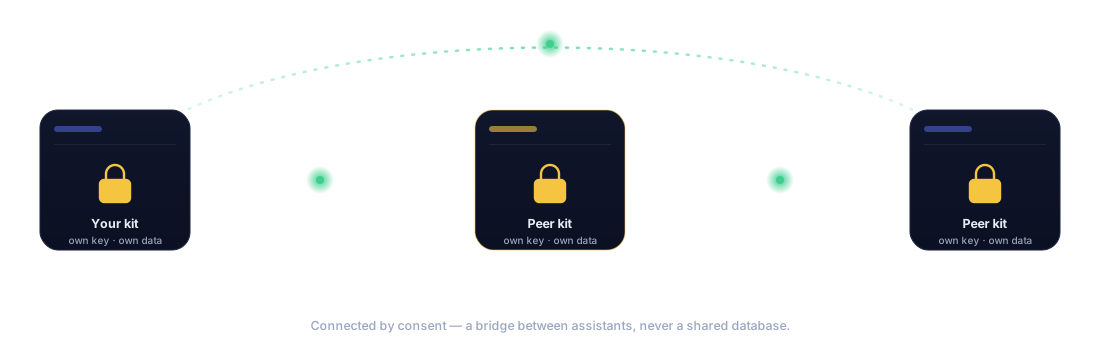
Federation isn't a shared server everyone logs into. It's a point-to-point line between two sovereign kits, opened by consent, closed by default. Nothing crosses that isn't deliberately sent.
Your assistant talks to a peer's assistant — point-to-point, kit to kit. Not a central hub, not a database both businesses dip into. The bridge carries a message between two intelligences; the data stays home on each side. A line, not a pool. A bridge between assistants, never a shared database.
Every cross-kit exchange is consented — and the default is closed. Fail-closed by design: if consent hasn't been given, nothing moves. You approve what crosses, in which direction, and you can revoke it. Consent isn't a checkbox bolted on at the end. It's the gate the bridge runs through.
Recognition without authorization. A peer can be recognized across the federation — seen, greeted, routed to — without being granted access to your data. The green card model that scopes access inside one kit now scopes it between kits too: known by default, let in only on purpose.
Federation is a rung, not a requirement. You start by owning your box outright — and connect to peers only if and when it serves you. Each rung up adds reach without surrendering an inch of ownership.
You hold the whole box and run it yourself. Own data, own key, own intelligence, on your own machine. The floor of the ladder is total ownership — everything above it is optional reach.
We architect your kit to your business and keep its engine sharp on a secure, consented update channel. Same sovereign box — you still own it — with a relationship behind it instead of a download.
Your kit joins a circle of sovereign peers over consented bridges. Assistants recognize and route to each other; lessons and referrals can cross — by your approval, never by default. Connection added to ownership, not traded for it.
The top rung: ongoing guidance and cross-kit coordination across a federation of sovereign businesses. A network held together by consent and shared intelligence — not by a platform that holds everyone's customers hostage.
Each rung is a choice you make, not a door that locks behind you. Own first; connect by choice. The federation grows your reach; it never takes your box.
The bridge carries only what you consent to send. Everything else stays sealed — not because we promise it will, but because the architecture won't let it leave.
Your personal and private data. Your keys. Your sovereign-layer content — the life you track alongside the business, your raw field, the things that were never anyone else's to see. None of it touches the bridge. It can't: the firewall is in the foundation, not in a setting.
A referral. A distilled message. A lesson worth sharing. Whatever the owner deliberately decides to send — and only that, only in the direction approved, only until it's revoked. The default is nothing moves. You open the gate; the gate closes itself behind you.
Privacy here isn't a privacy promise — it's privacy by architecture. A walled SaaS asks you to trust that it won't misuse the data it's pooling. The federation removes the need for that trust: the private data never leaves your box, so there's nothing pooled to misuse. Sovereign by default; connected only on purpose.
Tell us about your business and we'll architect a sovereign Steven Project kit you own outright — ready to stand alone, and ready to federate when you choose.